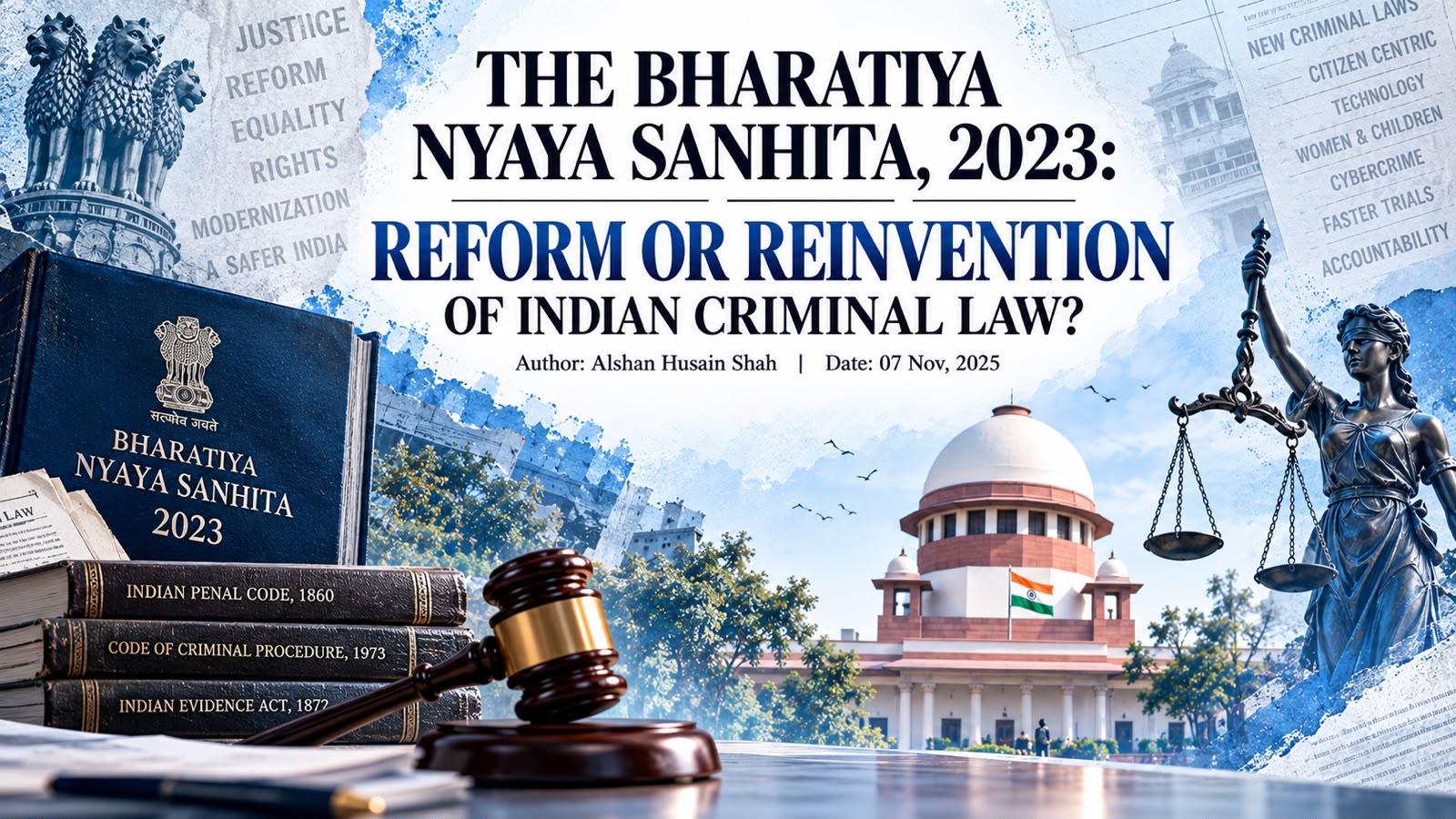
THE BHARATIYA NYAYA SANHITA, 2023: REFORM OR REINVENTION OF INDIAN CRIMINAL LAW?
Author: Alshan Husain Shah | Date: 07 Nov, 2025
Introduction:
On 1st July, 2024, The Indian criminal justice system had entered into an iconic era of reformation with the enforcement of the 3 new criminal laws: The Bharatiya Nyaya Sanhita (B.N.S.), 2023, The Bharatiya Nagarik Suraksha Sanhita (B.N.S.S.), 2023 and The Bharatiya Sakshya Adhiniyam (B.S.A.), 2023 replacing the old colonial era laws: The Indian Penal Code (I.P.C.), 1860, The Code of Criminal Procedure (Cr.P.C.), 1973 and The Indian Evidence Act (I.E.A.), 1872 respectively. This transformation of the major substantive criminal laws repealing the old laws in India took place for the very first time in over 160 years, marking a historic evolution of the Indian criminal jurisprudence till date. Now one may ask that is this really a genuine change which is aimed to modernize the old colonial era laws or it is just a mere renovation of the same old laws but under a new Indian name? We shall attempt to answer this question in this blog.
Historical Context:
The Indian Penal Code was drafted in the 1860 under the supervision of Lord Macaulay which was aimed to establish a backbone of the India’s criminal jurisprudence. This legacy maintained its worth for over a century and half in the Indian legal fraternity. While the provisions of IPC were remarkably aligned with the needs and requirements of the Indian society but it was considered as too punitive and authoritarian over the principles of justice and rehabilitation.
After the independence of India, there comes a number of committees and law commissions asking for a reform in the colonial era laws. The Malimath Committee (2000) and Madhav Menon Committee (2003) had both recommended the modernization, gender neutrality and a victim centric approach in the old laws and yet, the proper reforms remained unattainable in the old laws until the introduction of the new criminal laws in 2023 by the BJP government. The Bharatiya Nyaya Sanhita, 2023 was introduced as a part of the BJP government’s vision to decolonize the India’s justice system which aimed at making the criminal law as citizen centric, technologically advanced and a reflection of the India’s societal values.
Overview of The Bharatiya Nyaya Sanhita, 2023:
The Bharatiya Nyaya Sanhita, 2023 consists of 358 Sections as compared to 511 Sections in the previous law The Indian Penal Code, 1860, reflecting an attempt to simplify and merge the provisions in the Act. Many offences in the new law have been merged, reconstructed or even reclassified to align with the current modern context in the society.
Key highlights in the newly introduced law are:
- Introducing a citizen friendly language and structure in the new law unlike the technical language which was used in the old one.
- It aims to reduce the procedural delays and focuses on the digital effectiveness integrated in the investigation, inquiry and trial.
- It attempts to make the provisions for children and women stricter and clearer.
- It aligns the provisions of the act with the new technological advancements.
The Bharatiya Nyaya Sanhita, 2023 has also introduced a set of new and simple legal terms replacing the technical jargon of the colonial era law. While this reform seeks to promote the linguistic nature of the Hindi language into the Indian jurisprudence but it also raises some questions about its consistency in the interpretation of the Act across India’s diversified and multilanguage landscape.
Key Reforms Introduced:
1. Community Service as a Punishment: The Bharatiya Nyaya Sanhita, 2023 has introduced community service as a new punishment for petty or minor offences.
2. Stronger Protection for Women and Children: Provisions concerning the sexual offences, human trafficking and acid attacks have been made stringent and intact. The focus is on efficient trial and stricter sentencing.
3. Recognition of Organized and Cybercrime: New provisions concerning the organized crimes, terrorism and cyber offences have been introduced acknowledging the scope of the digital era.
4. Repeal and Replacement of Sedition: The colonial era provision of sedition (Section 124A of IPC) has been replaced with a new provision (Section 152 of BNS), which aims to penalize the “acts endangering the sovereignty, unity and integrity of India.”
5. Swift investigation and Trial Timelines: The Bharatiya Nyaya Sanhita, 2023 mandates stricter timelines for the purpose of investigation, filling of the charge sheet in the court and the completion of the trial, aiming at reducing the pendency and delay.
A Real Change or Continuity?
While the government presents the new law as a fresh piece of modernization of the older law but a closer look into the new laws reveals that there are substantial similarities. Studies show that almost 80% of the provisions are identical or only slightly modified in terms of the language. The core definitions of the offences such as theft, murder and criminal conspiracy remain unchanged in the new law but the reorganization of all the provisions is now more structured and intact.
Moreover, the rewording of the offences may result in confusion while interpretating although the intention is to simplify. Jurists and other legal scholars argue that a genuine reform does not only requires a linguistic change but a systematic evolution which is better at management and execution. It should provide a mechanism of digital case management system aligned with the advancing technology.
Judicial and Comparative Perspectives:
The Indian courts throughout the course of time have played a significant role in shaping the criminal jurisprudence that we know of today. In various landmark judgements such as Maneka Gandhi v. Union of India (1978) 1 SCC 248 and D.K. Basu v. State of West Bengal (1997) 1 SCC 416, The Hon’ble Supreme Court of India has expanded the meaning of Article 21: Right To Life and Personal Liberty to include fairness, dignity and procedural safeguards to ensure a fair trial. Comparatively, many countries like the United Kingdom, France and Singapore have also modernized their criminal laws but with the consultaion and advisory protocols of prominent jurists, legal scholars, professors, judges and lawyers to meet the required norms as per the standards of the legal sanctity. India’s challenge will be to ensure a rounded implementation and execution of the new laws so that it may fulfil its purpose of delivering justice in a fair and transparent way.
Conclusion:
The Bharatiya Nyaya Sanhita, 2023 is definitely a significant reform that attempted at replacing the long standing colonial era law, The Indian Penal Code, 1860. It portrays India’s dedication towards a new regime which is from the colonial legal legacies. Yet, it has its own complexities and shortcomings which can be corrected through some reforms and amendments.
The primary essence of the criminal law should be justice and not vengeance. The Bharatiya Nyaya Sanhita, 2023 will only achieve this goal with its real world application in the courts and police stations. Only then the true essence and the potential of the new law will be properly understood.

