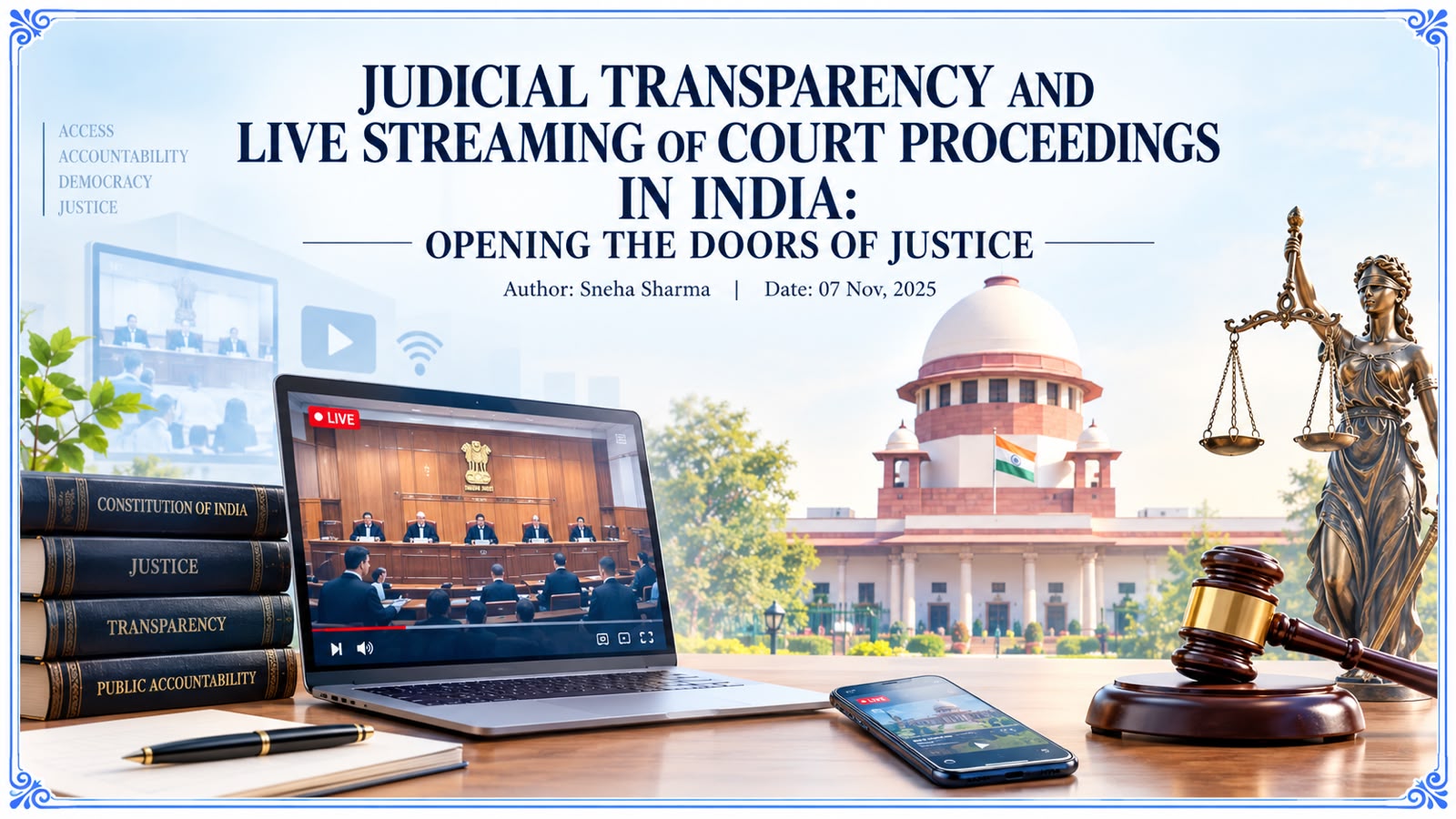
JUDICIAL TRANSPARENCY AND LIVE STREAMING OF COURT PROCEEDINGS IN INDIA: OPENING THE DOORS OF JUSTICE
Author: Sneha Sharma | Date: 07 Nov, 2025
Introduction
For decades, the Indian judiciary has stood as the sentinel of constitutional rights revered yet often inaccessible. Courtrooms, though open in principle, remained practically distant for most citizens due to procedural complexity and limited physical access. The introduction of live streaming of court proceedings represents a paradigm shift transforming judicial transparency from a theoretical ideal into a visible, digital reality.
This reform is more than a technological leap; it is a democratic experiment in public accountability, civic education, and participatory justice. Yet, like all experiments, it carries both promise and peril.
The Journey Toward Transparency
The movement began with Swapnil Tripathi v. Supreme Court of India (2018), where a three judge bench led by Chief Justice Dipak Misra recognized live streaming as an extension of the public’s right to information under Article 19(1)(a). The Court famously observed that “Sunlight is the best disinfectant,” affirming that openness strengthens trust in judicial integrity.
However, the Court was equally cautious exempting sensitive cases involving sexual offences, matrimonial disputes, and national security. This early balancing act between visibility and prudence continues to guide the judiciary’s approach today.
From Vision to Reality
India took a decisive step in 2022, when the Supreme Court live streamed proceedings from the Chief Justice’s courtroom for the first time. The symbolism was profound: the nation’s highest court, once seen as distant and esoteric, became accessible to millions. High Courts like Gujarat, Karnataka, and Madhya Pradesh soon followed, embracing YouTube based live streaming. The Gujarat High Court, in fact, pioneered the practice in 2020 proving that openness could coexist with decorum.
Globally, this aligns India with democratic jurisdictions such as the UK, Canada, and Brazil, where broadcasting judicial proceedings is routine. Yet, India’s context with its linguistic diversity, media dynamics, and digital divide makes this reform uniquely complex.
Benefits of Live Streaming
- Enhancing Public Trust:
Transparency enhances institutional legitimacy. When citizens can see judge question, reason, and deliberate, trust replaces speculation. - Legal Education and Research:
For law students and practitioners, live streaming turns the courtroom into a real-time classroom — an unparalleled resource for advocacy training and judicial reasoning. - Accountability and Conduct:
Awareness of public visibility encourages all participants — judges, lawyers, and even government counsel — to uphold professional ethics and discipline. - Democratization of Justice:
By breaking physical and geographic barriers, live streaming makes the judicial process accessible to the common person — bringing justice out of ivory towers and into civic consciousness.
Unique Insights: Beyond Transparency
- Transparency vs. Independence:
While openness breeds accountability, excessive public visibility can create subtle external pressure. Judges, aware of the digital gaze, may subconsciously temper their tone or reasoning. The goal should be transparent justice, not performative justice. - Participatory Constitutionalism:
Live streaming allows citizens to witness how the Constitution is interpreted in real time. It transforms passive spectators into informed participants, deepening civic engagement with constitutional values. - Digital Courtroom Ethics:
The absence of clear norms for media and public usage of streamed content invites distortion. India urgently needs a “Digital Courtroom Code of Ethics” to prevent sensationalism and misreporting. - Inclusion and Accessibility:
True transparency requires accessibility including multilingual subtitles, simplified summaries, and disability-friendly formats. Without inclusivity, live streaming risks
being elitist rather than democratic. - Data and Accountability:
Recorded proceedings could form a valuable judicial data archive, enabling analysis of case patterns, argument quality, and systemic efficiency. Transparency can thus evolve into data-driven judicial reform.
Challenges and Concerns
- Privacy and Sensitivity:
Broadcasting cases involving minors or sexual offences can endanger privacy and dignity. Judicial discretion in such matters remains crucial. - Media Misuse and Sensationalism:
Selective editing or sensational reporting could distort judicial reasoning and mislead public opinion especially in politically charged cases. - Behavioural Impact:
Cameras might subtly alter courtroom dynamics. Advocates could play to the gallery, and judges may become overly cautious. - Infrastructure Gaps:
Many courts still lack the technical bandwidth for consistent, high-quality streaming. Uneven implementation could deepen rather than bridge transparency gaps.
Balancing Openness and Restraint
The Supreme Court’s Model Guidelines for Live Streaming (2021) attempt to institutionalize a
middle path promoting transparency while safeguarding privacy and dignity. A promising approach could be delayed streaming or selective archiving, where sensitive hearings are uploaded after judicial clearance, not broadcast live.
Moreover, the judiciary must pair live streaming with media literacy initiatives, ensuring that
citizens interpret proceedings responsibly rather than react impulsively.
The Way Forward
Live streaming is just one facet of India’s broader digital justice transformation, alongside the e-Courts Project, virtual hearings, and National Judicial Data Grid (NJDG). To truly realize its potential, this initiative must evolve from visibility to meaningful engagement promoting understanding, accountability, and civic trust.
A possible innovation is the creation of a “National Judicial Transparency Portal” a centralized digital library archiving streamed proceedings, translated summaries, and related judgments for public and academic use.
Conclusion
The live streaming of court proceedings is a milestone in India’s democratic journey. It fulfills the constitutional promise that justice must not only be done but must also be seen to be done. Yet, as courts step into the digital age, transparency must remain a process, not a spectacle. When implemented wisely, live streaming can convert the courtroom from an elite forum into a public classroom of democracy where citizens not only watch justice unfold, but understand the principles that sustain it. This, ultimately, is the real victory of transparency not visibility alone, but trust through understanding.

