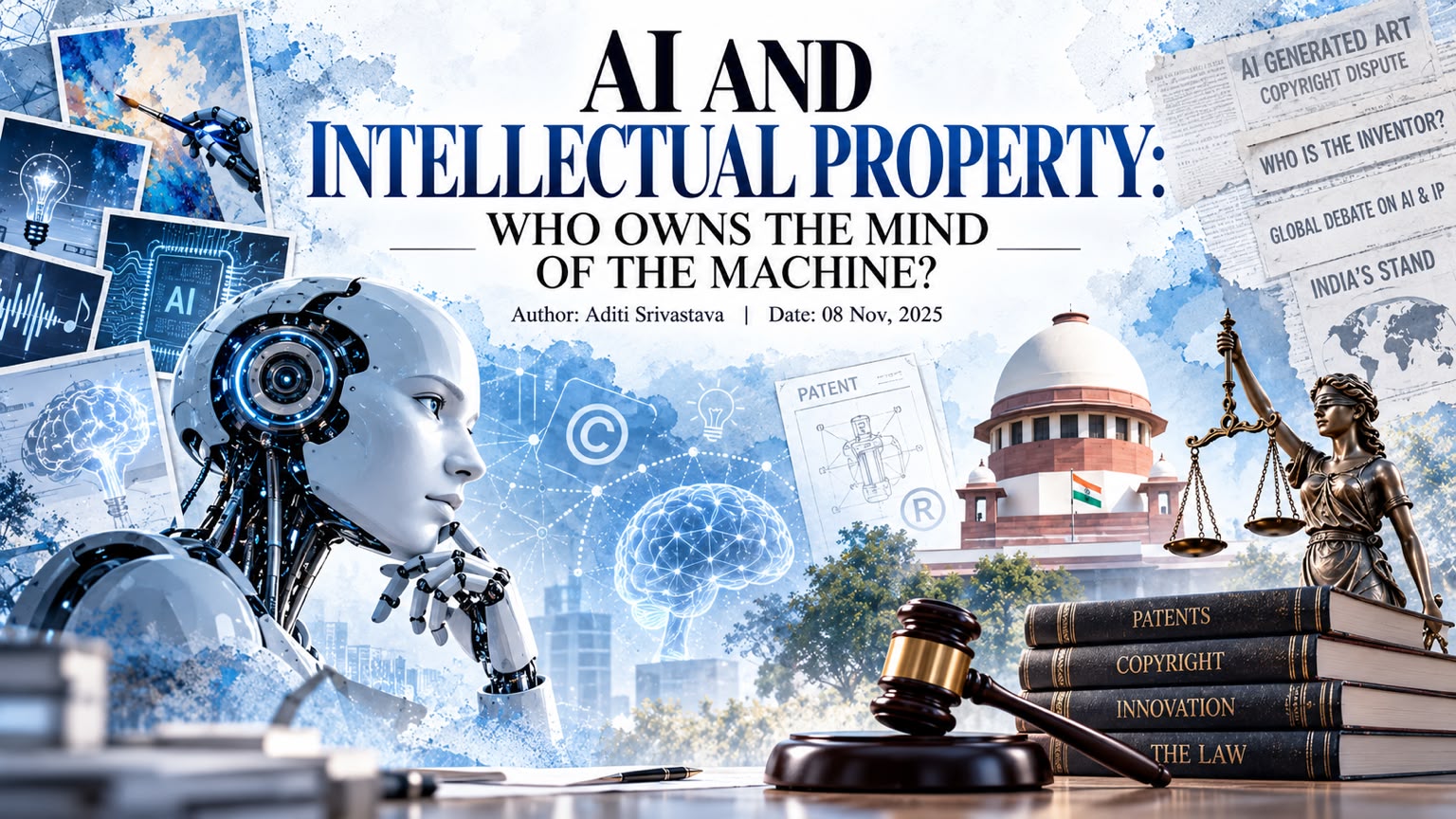
AI AND INTELLECTUAL PROPERTY: WHO OWNS THE MIND OF THE MACHINE?
Author: Aditi Srivastava | Date: 08 Nov, 2025
Introduction
In a world where machines can think, create, and even paint better than some humans, one question echoes through courtrooms and classrooms alike — who owns what AI creates? From AI-generated songs that top Spotify charts to digital art auctioned for millions, Artificial Intelligence has broken the traditional mold of creativity. But the law? It’s still trying to catch up.
When Machines Become “Creators”
Traditionally, intellectual property (IP) laws are built around human innovation — protecting the author, inventor, or artist. But what happens when a machine writes a symphony or invents a life-saving drug?
Take, for example, DABUS (Device for the Autonomous Bootstrapping of Unified Sentience) — an AI system whose creator, Dr. Stephen Thaler, tried to name it as the inventor in patent applications across the world. While South Africa accepted the application, the US, UK, and EU rejected it, insisting that only humans can be inventors. This split highlights a global dilemma: Can creativity without consciousness still deserve protection?
India’s Stand: The Human at the Helm
In India, the Patents Act, 1970 and Copyright Act, 1957 both revolve around human authorship. Section 2(d) of the Copyright Act defines an “author” in a way that assumes a person — not a program. Even though Indian creators are experimenting with generative AI, the law hasn’t yet recognized non-human creators. The Indian Copyright Office recently revoked an earlier registration that credited an AI tool as a co-author, reaffirming the human-centric stance. Still, with the government’s Digital India and AI Mission initiatives, it’s clear that India can’t stay on the sidelines for long. The question isn’t if we’ll regulate AI in IP law — but how soon.
Balancing Innovation and Protection
AI thrives on massive datasets — often scraped from publicly available content, including copyrighted material. This raises another problem: when AI “learns” from human works, is it inspiration or infringement?
The US case of Andersen v. Stability AI (2023), where artists sued AI image generators for using their artworks without consent, marks the start of a new wave of litigation. It’s a reminder that while AI might be innovative, it’s not immune to accountability.
The Road Ahead: Rethinking IP for the AI Era
The future demands a hybrid IP framework — one that acknowledges human creativity while accommodating machine-generated outputs. Some experts propose “AI-assisted authorship,” where humans supervising the AI retain ownership. Others advocate for entirely new rights categories, like Algorithmic IP or Data-Driven Creations. As policymakers debate, one truth stands out: AI isn’t just changing what we create — it’s changing what it means to create.
Conclusion: The New Frontier of Law and Logic
AI challenges the very foundation of intellectual property — originality, authorship, and ownership. The legal community now faces a defining moment: will we cling to old definitions or evolve to meet a new kind of creativity? For law students, researchers, and professionals, this is the perfect moment to watch — and shape — history. Because when machines can create, the law must learn to imagine.

